 AED 150
Yamaha 90cc
- Ages 9-12
- Own loop
- Supervised
Kept on its own loop near the base, well clear of the main dune route, so parents can watch the whole session from one spot.
Book this ATV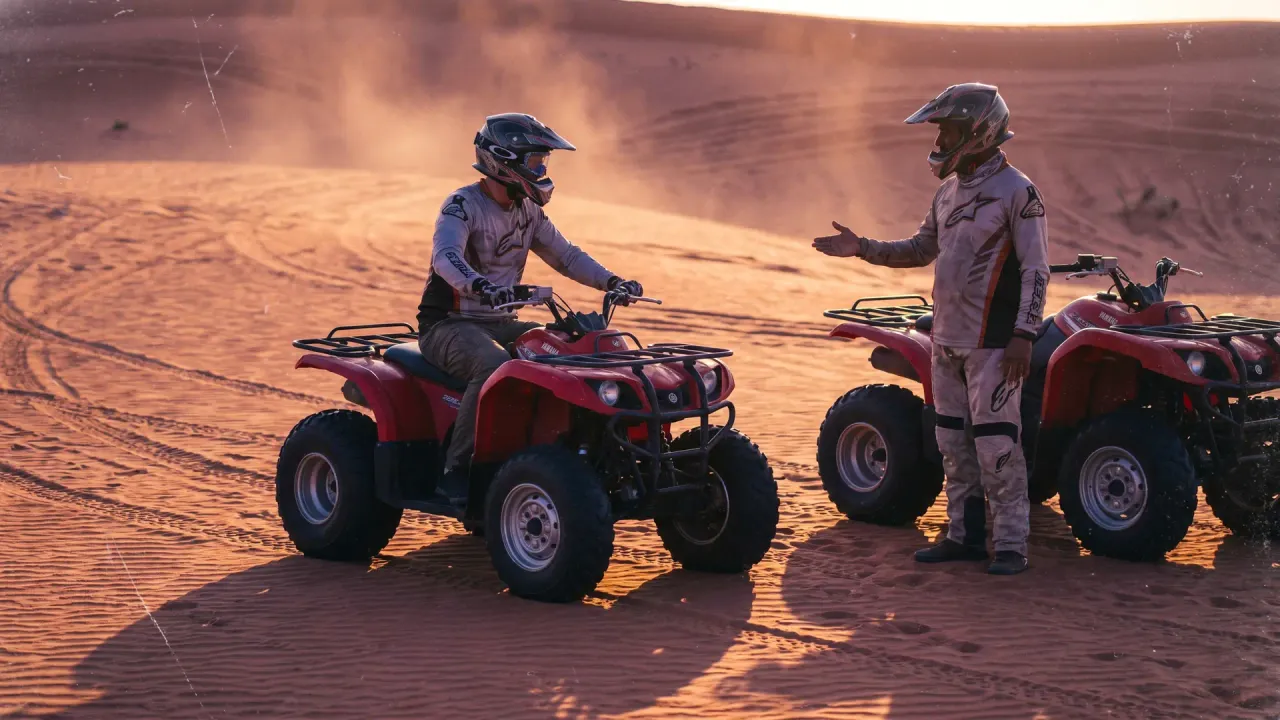
Al Lahbab is not the closest desert to the city, and that is the point. Forty-five minutes out gets you past the sand everyone else rides and onto a proper red dune field, with a Yamaha to yourself and a lead guide setting the line through it. Eight machines on the fleet, from a supervised 90cc for children up to the Raptor 700cc.
This fleet is based at Al Lahbab, the stretch of deep red dune roughly 45 minutes southeast of Downtown that this whole site is built around, rather than the sand closer to the highway. Machine choice sets the price: the 220cc opens up adult riding at AED 200, the 400cc is where most people actually end up at AED 250, and clearing the check for the Raptor 700cc costs AED 795. A separate, supervised 90cc lane is set aside for riders between nine and twelve, priced at AED 150.
For one booking that covers the most ground, the Evening Desert Safari, ATV and BBQ at AED 375 is it — dune bashing, your own machine, and a camp dinner once the light drops, the package that outsells everything else here. Secure online advance payment confirms your booking, support available 24/7.
Each machine seats one rider, so every price below is a per-person fee, except the 400cc double, built specifically to carry two on a single ticket. No payment gets taken until the machine, the timing and pickup are all locked in.
| Machine | Suits | From |
|---|---|---|
| Yamaha 90cc | The supervised loop for riders 9 to 12, guardian close by. | AED 150 |
| Yamaha 220cc | A first throttle, full stop. Light, steady, forgiving of a shaky start. | AED 200 |
| Yamaha 400cc | What the standard Al Lahbab route is actually built around. | AED 250 |
| Yamaha 400cc double | One seat, two riders, a single fee between them. | AED 350 |
| Yamaha 400cc turbo | Same frame, more pull out of a bowl — the usual second-visit pick. | AED 350 |
| Yamaha Grizzly 450cc | A heavier, planted machine for the longer routes further into the dunes. | AED 450 |
| Sports quad 625cc | Sharper handling that punishes a lazy line. For riders with real hours logged. | AED 700 |
| Yamaha Raptor 700cc | Top of the fleet, handed over only after a short rider check. | AED 795 |
A guide leads every single ride, which is exactly why machine choice matters less here than newcomers expect — go with whichever one feels comfortable, and your route gets built around that choice rather than the reverse.
AED 150Kept on its own loop near the base, well clear of the main dune route, so parents can watch the whole session from one spot.
Book this ATV AED 200
The machine most first-timers end up grateful for. Nothing about it punishes hesitation, which is exactly what a first session on soft sand needs.
Book this ATV AED 250
Built around the standard Al Lahbab loop specifically — enough power for the climbs, nothing that outruns a rider still finding their balance.
Book this ATV AED 350
Solves the pairing problem in one move: two people, one machine, one fee, for when only one of you actually wants to ride solo.
Book this ATV AED 350
The machine returning riders reach for by name. Same familiar frame as the standard 400cc, noticeably more shove out of a soft climb.
Book this ATV AED 450
Built for the longer stretches further into the dune field, where a heavier, steadier frame earns its keep over broken ground.
Book this ATV AED 700
Rewards a rider who moves with the machine rather than sitting still on it. Ask for this one only if that description actually fits you.
Book this ATV AED 795
Asking for it is not enough on its own — a quick chat about what you have ridden previously happens first, before this one gets cleared for the dunes.
Book this ATVThe riding itself takes roughly an hour, while the round-trip drive alone swallows about ninety minutes. Tacking a safari or the camp dinner onto the ATV session is what makes that drive time worthwhile, and it is exactly why so many people book the pairing instead of the ride by itself.
 AED 375
A Land Cruiser handles the dune bashing, you handle the ATV leg on the same red sand, then a Bedouin-style camp once the light drops. The most-booked pairing on this site.
Book this tour AED 290
Overnight cool keeps the sand a touch firmer, which makes the early climbs easier if this is your first time on a machine. Back in the city with the afternoon still free.
Book this tour AED 700–1,300
Skip the Land Cruiser leg, keep the ATV and the camp. Built for anyone who would rather not be driven fast over dunes before dinner. Price shifts with the machine picked.
Book this tour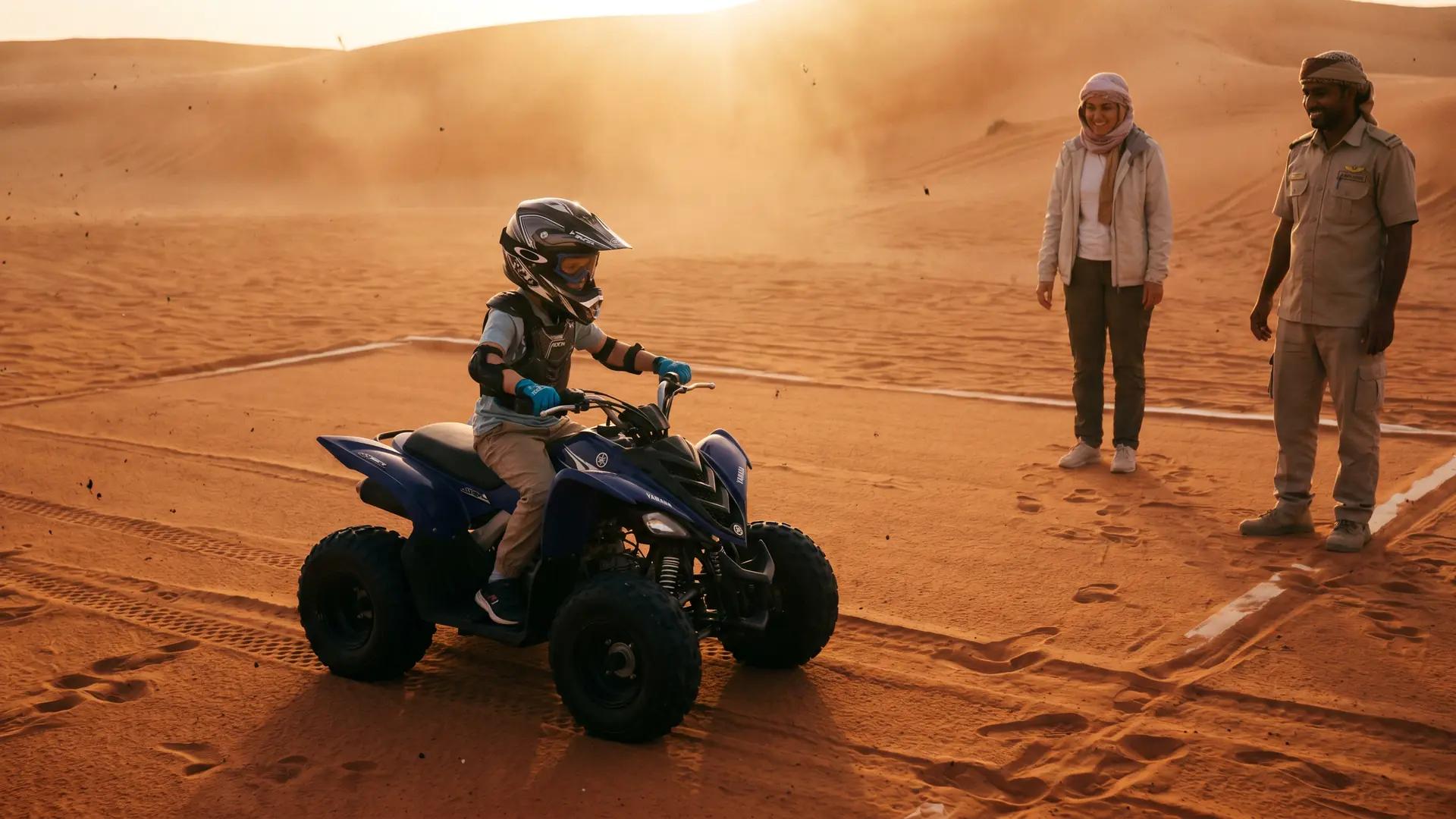 AED 150
Kids loop the 90cc track while the adults take the full Al Lahbab route, both groups working out of the same base at the same time.
Book a family tourDriving a car does not count for this one — think motorbikes, jet skis, anything steered with a throttle under your right hand.
Getting to Al Lahbab takes longer than a lot of first-time visitors budget for, and that changes how this booking should actually be planned.
Swap the open seat of an ATV for a roll cage and a steering wheel and you have got the buggy side of this fleet — still room for passengers, still parked at the same Al Lahbab yard, which is exactly why so many bookings here mix the two rather than picking just one.

Steering wheel and foot pedals instead of handlebars, and a far shorter learning curve if your line drifts a little on the way into a dune.

Wide-bodied with long-travel suspension for the rougher lines, and priced once per machine rather than per person riding in it.
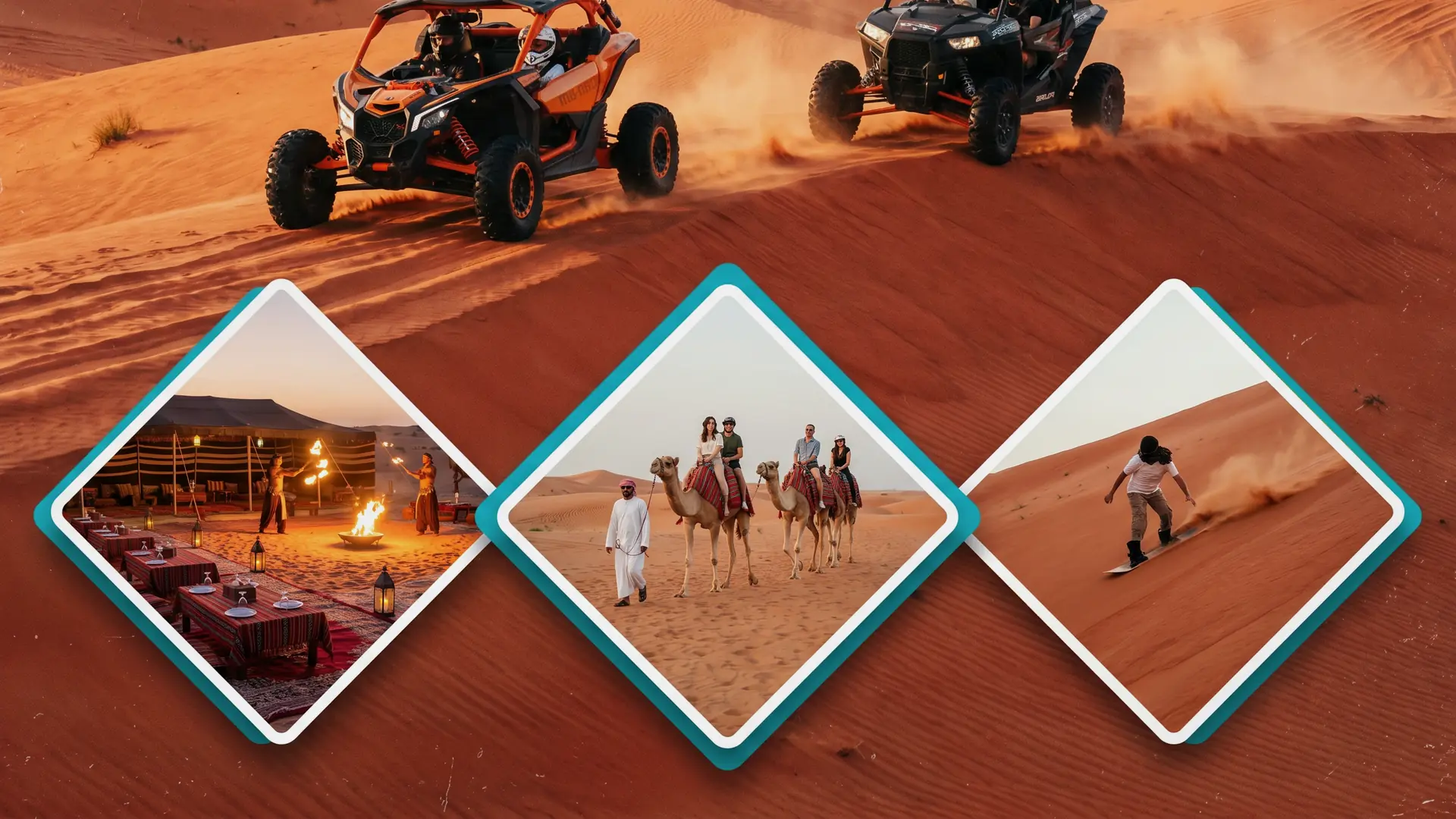
Start on four wheels under your own power, then hand off to the buggy once that first stretch has taken the edge off your arms. With the exact machines locked in, the total typically falls somewhere between AED 290 and AED 1,100.
Everything else on this site starts with a price tag; this starts with a few questions instead. Balance mistakes that a four-wheeled machine shrugs off on loose sand show up immediately on two wheels, and nothing about a KTM steps in to save you the way an ATV or a caged buggy would.

One hour on the 450 costs AED 850; keep going for a second and the total becomes AED 1,250 — though neither number matters unless you can point to real off-road time already logged, since enthusiasm by itself will not get you past the check.

This one stays off the rack until a guide has watched you handle something else first and signed off on the advanced route. Cost gets settled in that same conversation, not printed on a list.

Guide waved you off the KTM? The Raptor 700cc keeps you on the same dunes with nearly the same adrenaline, just steadied by two extra wheels underneath you.
From AED 225, a professional driver takes over the dune bashing in a Land Cruiser on the very sand the ATVs ride. Mixed groups rarely have to pick just one activity — most add a safari on top of whatever machine they have already booked.

Out the door early while the overnight cool still holds, back in the city well before lunch.

Dune bashing carries on until the ridgelines catch the sunset colours, then everyone regroups at the Bedouin camp for a halal barbecue dinner, with transfers covered both ways.

The vehicle is exclusively yours for the drive, and so is the seating area once you reach camp — no other group's plans folding into your evening.
There is more beyond the packages listed here — a private morning slot runs AED 799, a private evening climbs to AED 1,400, and both overnight camping and corporate bookings can be arranged directly. Motion sickness is not a reason to skip the camp either; a gentler route without any dune bashing gets there just the same.
Pickup happens well before sunrise, 4:30 on the clock, with the basket back on the ground before most hotels have finished setting out breakfast. Flights operate September through May, and of everything bookable on this site, this is the one most exposed to weather — a gust that would barely register on an ATV session is enough to ground a flight.
Well suited to the youngest riders, to grandparents happy to watch rather than ride, and to anyone who clocked the Raptor's speed from a safe distance and decided a slower pace suited them better.

A guide leads the walk across the same dune field the ATVs ride, open to children from age three with an adult alongside.

This one skips the 45-minute desert drive entirely since it happens right on the JBR shoreline, and it is usually the single shot every visitor is chasing on this list.
For riders who already know their way around a saddle, horseback treks through the same desert start at AED 575.
Combo pricing is not printed anywhere on this page, because it depends on too many moving parts — how many of you are riding, which machines you want, and how many hours of the Al Lahbab day you are booking out. Message the specifics across and expect a number back before the day ends.

Stack ATV, buggy, safari and BBQ into one day and the running total usually settles between AED 700 and AED 2,200. Open with a sunrise balloon flight beforehand for the fully loaded version.

Twelve-plus riders get divided between the ATV and buggy fleets under the same guiding team, all moving to a single schedule instead of separate staggered time slots.
One location covers this entire fleet — ATV, buggy and dirt bike alike — and it does not change by date: Al Lahbab, past the southeastern edge of the city along the Dubai–Al Ain road. The photos on this page are not staged either; the bowls and ridgelines are real, not the flattened mounds found on the stretches closer to the highway.
Every machine starts on flat ground near the base rather than heading straight for a dune — that warm-up stretch does most of the safety work on its own, letting a guide judge how much terrain each rider can actually handle instead of relying on whatever was ticked on a form online.
Book the standard loop or stack a full-day combo — either way, the six steps below play out the same; the amount of time spent riding is the only variable that moves.
Self-drivers get a pin for the Al Lahbab meeting point once the booking clears; anyone starting from a hotel is collected and driven out for the 45-minute run southeast of the city.
Machines get inspected first, then the walkthrough covers throttle response, braking, body position on rough ground, and the hand signals the lead rider uses out on the dunes.
A stretch of flat sand near base is where the guide actually decides your route, watching how you handle the machine before anything steep is on the table.
From the warm-up straight into the bowls and ridgelines that give Al Lahbab its colour and its shape, riding nose-to-tail behind the lead machine with stops built in along the way.
Back at base for water and a breather, the day's photos handed over on the spot, before the drive back into the city or straight into whatever combo was booked.
Booked the BBQ? The group heads straight from the dunes to the camp from here, no separate trip required.
A guardian stays with the group whenever a rider is in the nine-to-twelve bracket working the supervised 90cc. Kids below that cutoff are not shut out either: a buggy still has room for them in the passenger seat beside whichever adult takes the wheel, or they can climb onto a camel from age three onward. Anyone in your party sitting right on one of these edges is worth mentioning at the time you book, not once everyone is already standing at the briefing, because that is genuinely the only window where a fix is still easy. On paper, the licence behind every booking here was issued by the DTCM to Dream Land Adventure Tourism. Out on the dunes, though, it is the guide standing in front of you who makes the call, not a policy printed on a page.
Based on 968 Google reviews
Based on 1,153 reviews
Eight Yamaha machines make up the fleet, each priced per rider. The supervised 90cc is AED 150 for riders between nine and twelve, the 220cc is an adult's starting point at AED 200, and the 400cc — where most people end up — runs AED 250. Clearing the check for the Raptor 700cc costs AED 795. Bundle in the evening desert safari and BBQ camp and the combined price comes to AED 375, which outsells every other package on this site.
Yes. Every activity listed here — ATV, buggy, KTM, Land Cruiser safari, camel trek — operates out of the same Al Lahbab base, so a mixed group booking two or three different activities is never split across two locations or two drives.
No, but it is where this operator bases its fleet, and where the red-sand photos everyone searches for actually come from. A few other desert areas nearer the city host ATV activity too — the comparison between them is covered in the location guide further down this page.
No. The 220cc is built around riders who have never touched a throttle, and the warm-up circuit on flat sand exists specifically so a guide can judge your control before any route gets steep. Mention you are new to it at the briefing rather than after.
Nine, on the supervised 90cc loop, with a guardian stationed at the track. Below that age a child can still ride along as a buggy passenger next to a driving adult, or take a camel from age three.
Hotel pickup is quoted and confirmed as its own line item before you pay, rather than folded into the machine price. Regular collection areas include Deira, Business Bay, the Marina, JBR and Downtown. Prefer to drive yourself? A pin for the meeting point goes out as soon as the booking is confirmed.
Count on most of a half day once travel is added in, given the drive out to Al Lahbab runs close to 45 minutes each way from the city. The ride itself runs a fixed length, but that round-trip drive is exactly why a safari or a BBQ usually gets tacked on rather than the session being booked by itself.
Guided throughout. Each rider gets their own machine, but the group moves as a pack behind a lead rider who sets the pace, controls spacing and calls every stop. Nobody rides out into the dunes solo.
Shoes need to be closed-toe, sunglasses are a good idea, and whatever you wear should be something you would not mourn once sand works its way into every seam of it — helmets are supplied on site, so that part is covered. If there is one thing worth prioritising in your bag, it is a buff or scarf to cover your face; leaving a spare set of clothes in the car also makes the ride home a lot more comfortable.
Most sessions see it happen to someone at least once, typically when the throttle gets eased back too early halfway up a loose face. The guide loops back, frees the machine, and the group carries on — no charge involved, and it rarely eats more than a couple of minutes.
An ATV works when everyone in your group wants a machine of their own, since the fee is charged per rider. A buggy instead if driving duty really only appeals to one or two of you, since a single fee covers the entire vehicle and everyone riding in it. Groups with a mix of confidence levels often book both and ride together.
Yes, shifted to the cooler ends of the day. From roughly late May to September, sessions move to early morning or late afternoon rather than midday, since open sand under a midday summer sun is genuinely hard going. October through April runs comfortably in daylight.
A sandstorm or strong wind does not cancel the booking outright; it moves you into a different slot instead, and you will hear about the change well ahead of time, at no added cost. ATV sessions tolerate marginal weather better than almost anything else bookable on this site — balloon flights are usually the first thing grounded once conditions turn.
A weekday booking is usually fine with just a few days' warning. Aiming for Friday or Saturday instead? Give it closer to a full week — late-afternoon slots disappear fastest, and the Raptor 700cc is rarely far behind them. Secure online advance payment confirms your booking, support available 24/7 — after that, WhatsApp is where your exact pickup time gets locked in the day before.
ATV Desert Dubai runs its fleet from Al Lahbab, a stretch of deep red dunes roughly 45 minutes southeast of Downtown Dubai, chosen over the paler, more trafficked sand closer to the highway specifically for its colour, its dune size, and the room it gives a guide to run a controlled route away from public through-traffic. The fleet runs eight Yamaha machines deep, starting at a supervised 90cc for nine-to-twelve-year-olds at AED 150 and topping out with a rider-screened Raptor 700cc at AED 795, with most adults settling on the 400cc at AED 250. The same location hosts dune buggies from AED 599, KTM dirt bikes from AED 850, Land Cruiser desert safaris from AED 225, camel treks from AED 150 and sunrise balloon flights from AED 1,049, so a mixed group never gets split across two different desert bases.
Most bookings add the Evening Desert Safari, ATV and BBQ package at AED 375 on top, scheduled so the ride falls right as the location's exposed dune faces start cooling off for the evening — the most-booked package on this site. Secure online advance payment confirms your booking, support available 24/7.
The Land Cruiser takes care of the dune bashing, then it is your turn on an ATV across that same red sand, before the day winds down at a Bedouin-style camp under the evening sky.
AED 375Light and forgiving, built for a first-ever throttle rather than a fast lap.
AED 200What the standard Al Lahbab route is built around, and where most adults land.
AED 250Cleared rider by rider before the keys change hands, and the fastest machine on the dunes.
AED 795Its own supervised loop away from the main route, for riders nine to twelve.
AED 150A roll cage and harness instead of an open seat, for anyone who would rather not ride exposed.
From AED 599Reserved for riders with real off-road hours already logged elsewhere.
From AED 850Lifts off before the ATVs are even fuelled, the whole dune field laid out below.
From AED 1,049Distance from the highway, dune size, and control over the ground. Al Lahbab is far enough out that an operator can hold a real stretch of desert without random public traffic crossing the route, and the dunes are tall and continuous enough to build an actual loop rather than a short flat lap.
Not every patch of sand around Dubai works as a base for a guided fleet, whatever the "desert near me" search results suggest. A location needs enough open ground to lay out a warm-up area plus a real route without the same fifty metres getting ridden on repeat, and it needs to be held under some kind of lease or permit so an operator can actually control who else is out there. A pocket of dunes wedged between a highway and a housing project might photograph fine, but it rarely has either of those two things.
The desert closest to the city edge tends to fail on both counts at once. It is popular precisely because it is close, which means self-drive tourists, other tour companies and the odd photographer are usually working the same small stretch of sand at the same time. Guides lose the ability to set a clean route because there is always a chance of another vehicle appearing over the next ridge, and the dunes themselves get compacted faster under that volume of traffic, which changes how they ride.
Al Lahbab solves both problems by being further out. The extra distance is exactly what keeps casual through-traffic down, and the dune field there runs deep enough that a proper loop fits without doubling back over ground already ridden that day. That is also where the eight-machine fleet is actually based rather than trucked out for the day, since keeping the operation on one stretch of desert is what makes a consistent warm-up-then-route structure possible in the first place — a shorter list of locations than the number of places that simply have sand.
Deeper and more consistent. Al Awir's dunes, closer to the city, run flatter and more tan than red. Big Red is genuinely red but concentrated in one famous, heavily visited mound rather than spread across a whole riding area the way Al Lahbab's dune field is.
All three sit somewhere along the same Dubai–Al Ain corridor, which is why they get compared so often, but the sand itself is not identical. Al Awir, being nearer town, tends toward a paler, more gravelly tan, with dunes that are lower and more broken up by tracks, farms and the odd camel enclosure. It is desert, but it does not carry the deep rust colour people picture when they search for red-dune photos.
Big Red earns its name honestly — it is a genuinely striking, tall red dune, and one of the most photographed single landmarks in the whole area. The catch is in that word "single." Big Red is largely one dominant mound close to the Hatta road, drawing heavy day-tripper and self-drive traffic precisely because it is so recognisable and so close to the route out toward Hatta. Great for a five-minute photo stop or a sandboarding run down one face; less workable as the base for a full guided ATV loop, since there is only so much dune to go around before routes start crossing each other.
Al Lahbab's red runs across a wider stretch rather than one mound, with the colour holding fairly consistently over a real dune field rather than concentrating in a single landmark. That spread is what actually matters for a tour, since a guide needs enough distinct terrain to lay out a warm-up area and a longer loop without every group riding the same three dunes. The same Land Cruiser safaris run their dune-bashing routes across that same stretch for exactly this reason.
None of the three is objectively "better" desert in isolation — Al Awir suits a quick camel photo, Big Red suits a quick stop on the way to Hatta. Al Lahbab is simply the one built for a longer, guided session, which is the specific thing an ATV tour actually needs from its ground.
Around 45 minutes, heading southeast out of Downtown on the Dubai–Al Ain road. That travel time alone is why a half day, not a couple of hours, is the honest budget for a single ATV session.
Forty-five minutes is the number quoted, and it holds reasonably well from most central pickup points — Downtown, Business Bay, the Marina — since the route runs in more or less a straight line southeast out of the city rather than weaving through multiple districts first. Traffic on the way out of town during a morning rush can stretch that somewhat, which is part of why early slots get a slightly earlier pickup window than the number alone suggests.
The drive itself changes character in stages rather than all at once. The first stretch is standard city and suburban road, past the last of the warehouses and labour accommodation blocks that line the edges of Dubai's outward sprawl. Buildings thin out, the road opens up, and gravel plains dotted with scattered farms and the occasional camel take over from rooftops. The final few minutes leave the sealed road for a compacted track running into the dunes themselves, which is usually the point where phones come out for the first photo of the trip.
That round trip is the main reason a standalone ATV session rarely fills a whole outing on its own. Ninety minutes of driving against a booked session of a set length means the actual riding is a smaller share of the day than most first-timers expect, which is exactly why combining the ride with a desert safari or the BBQ camp is the more common booking rather than the exception.
Self-drivers get a pin for the meeting point once a booking is confirmed rather than a fixed street address, since the last stretch runs on unmarked desert track rather than anything a standard map app resolves cleanly on its own. Anyone collected from a hotel skips that step entirely and gets driven the whole way.
Managed. The stretch this fleet rides is held under licence rather than open to anyone who drives out with their own vehicle, which is what lets a guide actually set routes, spacing and a warm-up zone instead of sharing the sand with unrelated traffic.
"Open desert" suggests anyone can turn up and ride wherever they like, and parts of the wider area around Al Lahbab do work that way for self-drive 4x4 owners. The ground this operator actually uses is different — it is run under a Dubai tourism licence, with a defined base, a marked-out warm-up area near that base, and routes a guide chooses rather than terrain left to chance.
That distinction is what makes the whole guided structure possible in the first place. A warm-up circuit only works as a genuine safety check if the guide can be reasonably sure no unrelated vehicle is about to appear from behind a dune mid-session. Spacing riders out, calling stops, and picking a route to match a rider's ability after the warm-up all depend on that same basic control over the ground, covered in more detail on the safety and suitability page.
It also explains why there is no licence requirement to ride here, despite the machines reaching real speed. Public-road rules exist because public roads are shared with people who never agreed to be part of the risk. A managed private stretch of desert, with one operator controlling who rides and when, is a different setting — predictable about who else is out there, though no less a real dune underfoot, with real elevation change, soft faces and the odd stuck moment along the way.
Fine, deep, wind-shaped grain that holds a rounded dune face rather than crusting hard or turning gravelly. That texture is what lets a guide build routes with real elevation change while still giving a machine something to dig into on the climbs.
The red colour itself comes from iron oxide staining on the individual grains, a well-known and fairly simple fact about how this part of the desert got its tone — it is not a different mineral underneath, just an oxidised coating on the same silica grains found across the wider region. What actually matters for riding has less to do with colour and more to do with how fine and how deep that sand sits, and how consistently the wind has shaped it into proper dune faces rather than a flatter, harder-packed plain.
Compare that with gravel-heavy ground closer to the city edge, which tends to be firmer underfoot and less forgiving on a fall, or with the compacted, well-trodden tracks that build up wherever a lot of vehicle traffic crosses the same patch repeatedly. Soft, deep dune sand behaves differently under a set of tyres than either of those. A machine can dig in and claw up a loose face in a way it simply cannot on hard-packed ground, and a low-speed tip-over into soft sand is a far gentler event than the same fall onto compacted earth.
That same softness is also what makes the warm-up circuit meaningful rather than a formality. A guide watching a rider handle a soft, shifting surface for the first time learns a lot more about their control than the same rider would show on flat, firm ground, which is part of why the route only opens up once that read has happened. It is also part of the reason a dune buggy on the same sand needs long-travel suspension to smooth out what an ATV rider feels directly through the bars — none of it unique to Al Lahbab chemically, since plenty of Dubai's inland desert shares the same iron-stained sand, but rarely in dunes this tall and continuous.
Yes — Big Red and the Al Awir stretch both see quad and ATV activity, along with pockets further toward the Hatta road and across the Sharjah border. None combine the colour, the dune size and a single managed operator base quite the way Al Lahbab does.
Big Red sees plenty of ATV and quad activity, much of it built around short sessions or single-dune sandboarding runs rather than a longer guided loop, simply because there is less open ground to spread a route across once a location is centred on one dominant mound. Al Awir, being flatter and closer to town, tends to host a mix of activities — camel rides, smaller day-tour operations, the odd photo-stop 4x4 excursion — rather than functioning as a dedicated ATV base.
Further out toward Hatta and across into neighbouring Sharjah, the terrain shifts again, trading dune fields for rockier, hillier ground that suits a different kind of off-road driving altogether rather than the soft-sand riding an ATV is built for. That terrain has its own following, but it is a genuinely different activity, closer to rock-crawling than dune riding, and not really a fair comparison against a red-dune ATV session.
What tends to separate a location that merely sees some ATV traffic from one built as an actual operator base comes down to the same three things already covered above — enough continuous dune to lay out a real route, sand consistent enough to keep sessions predictable, and a licensed, managed stretch rather than shared, open ground. Al Lahbab checks all three boxes at once, which is less common than the number of red-tinted photos online might suggest.
For a rider comparing options rather than just picking whichever name shows up first in a search, the honest answer is that several places near Dubai will sell you an ATV session. Fewer of them can offer a full guided loop across proper dune terrain rather than a short lap on a smaller patch of sand, and that gap is really what separates a base like this one from a location that just happens to have some sand and a rental stand.
Yes, mainly because of how exposed and inland Al Lahbab is — no coastal breeze, no shade structures, open dune faces holding direct sun most of the day — which is why certain slots consistently ride more comfortably than others here specifically.
Being inland rather than coastal matters more than people expect. Dubai's beachfront areas get some relief from sea air moving across them; Al Lahbab, sitting well inland on open desert, does not get that same buffer, so temperature swings between morning and midday tend to feel sharper out there than they do back in the city. That is a function of where this particular stretch of desert sits, not a general statement about Dubai weather.
The dunes themselves add to it. Open, exposed dune faces with no tree cover or built shade hold direct sun for most of the daylight hours, and a rider on an ATV has no roof or windscreen breaking that exposure the way a car cabin would. Combine an inland location with that kind of open terrain and the practical result is that the same ride feels genuinely different depending on what hour you book it for, more so than it would somewhere closer to the coast or shaded by structures.
That is the real reason early morning and late afternoon slots get recommended so consistently for sessions here, particularly through the hotter half of the year — it traces back to the location's own exposure rather than a generic seasonal rule copied from elsewhere. The Evening Desert Safari, ATV and BBQ package leans directly into this, timing the ATV leg for the point in the day when the dune faces have already started shedding the heat they picked up earlier.
None of this changes what machine suits a rider or how the warm-up works. It changes which hour of the day makes the same session more comfortable, and that is a direct consequence of riding somewhere open and inland rather than somewhere closer to the city or the coast.
No. This fleet rides on privately managed desert land held under a Dubai tourism licence, separate from any protected conservation reserve. That licensing is what allows a guide to control routes and spacing in a way riding inside a protected area would not permit.
Light does most of that work. The same iron-oxide-stained sand can photograph anywhere from a warm orange at midday to a much deeper red in the low light of early morning or the last hour before sunset, which is part of why those two windows are also the most popular for photos, not just for temperature.
As a quick stop or a sandboarding run, yes, plenty of people do exactly that on the way to or from Hatta. It is not a substitute for a guided ATV session, though, since it is built around one landmark dune rather than a spread-out route.
Yes, the route runs near or through parts of Al Awir before continuing on toward Al Lahbab, so the sand's colour and the terrain both visibly change over the course of the drive rather than switching abruptly at one point.
That is essentially what the warm-up already sorts out. A guide reads how you handle soft sand during that flat-ground stage and shapes the rest of the route around it, so a rider who is clearly more comfortable on gentler terrain is not pushed onto the steepest faces regardless.
Yes, the same stretch hosts both. A safari's dune-bashing route and an ATV's guided loop cover overlapping ground, which is also why a combined booking, ATV plus safari, does not involve any extra travel between the two.
A quick photo stop on the roadside shoulder is not the same activity as a guided, multi-machine ATV session running a set route for an hour or more. Operating that kind of structured activity on a specific stretch of desert is what the tourism licence actually covers.
It can leave a light dust residue the way any sand would, but it is not a dye and it washes off normally. Riders in pale clothing tend to notice it more simply because the contrast shows, not because the sand behaves any differently than other desert sand would.
Broadly, yes — the warm-up area near the base sits on flatter ground before the route climbs into taller dunes further in, and that is by design. Beginners spend more time on the flatter stretch; the taller terrain further out is reserved for riders the guide has already seen handle a machine well.
The wider Al Lahbab area does host more than one operator, but each runs its own licensed patch and its own routes, so groups are not sharing a route with a different company's convoy mid-session.
Choose your machine, lock it in with secure online payment, and WhatsApp will confirm your exact pickup slot the evening before you roll out to the dunes.

